 NandakishorandClaude Opus 5
28d43add7e
NandakishorandClaude Opus 5
28d43add7e
Evidence behind the numbers in the main README. Not imported by the package.

- scripts/: Colab T4 head-to-head, 51-language CPU sweep, the six application
  workflows, routing-aware latency, and the plot renderer
- results/: 17,416 questions on a T4 and the 51-language sweep, raw JSON

Headline: routing takes coverage from 23 to 45 of 51 languages. The English
checkpoint macro-averages 0.227 with macro ECE 0.733 and reports 0.952
confidence on Khmer while scoring 0.000, so confidence gating cannot catch the
failure and the decision has to be made before the forward pass.

Co-Authored-By: Claude Opus 5 <noreply@anthropic.com>

Multilingual, non-autoregressive System 1 decision engine. Typed decisions over 100+ languages in a single forward pass — 33 ms — trained with reinforcement learning against strictly proper scoring rules (RLCD), with a router that picks the right checkpoint per request.








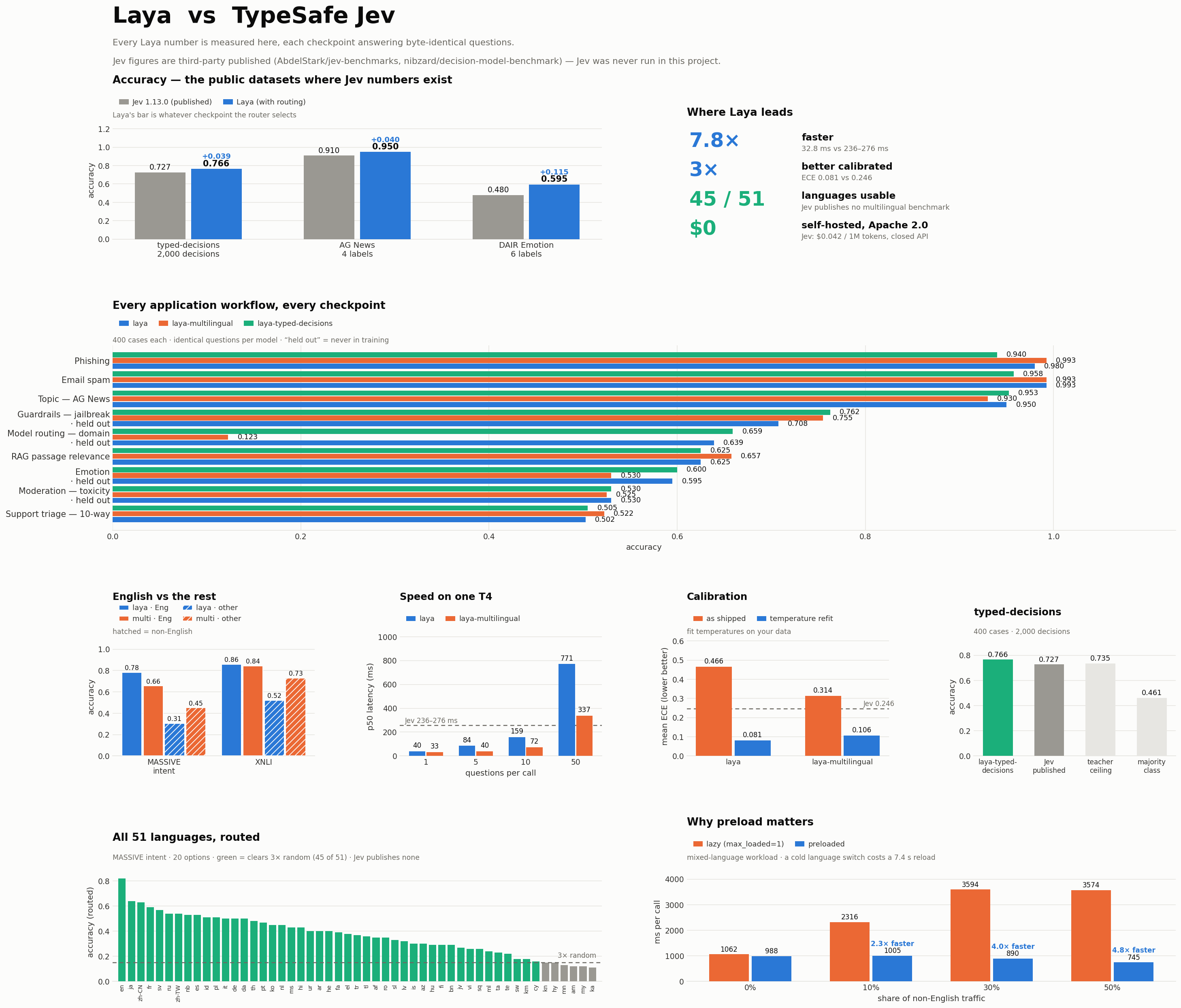
Laya evaluates typed questions (choice, score, noul) over any state (text, email, ticket or JSON document) in a single forward pass — 33 ms for one question, 7.2 ms/question batched, measured on a T4. No text generation, so nothing to parse and nothing to hallucinate.
Three checkpoints, and a Router that picks between them per request:
| encoder | params | context | use it for | |
|---|---|---|---|---|
laya |
ModernBERT-large | 421M | 512 | English |
laya-multilingual |
mmBERT-base | 322M | 1024 | 100+ languages, 2x faster |
laya-typed-decisions |
ModernBERT-large | 421M | 1024 | the typed-decisions workflows |
Installation
pip install laya
Quickstart
import laya

# 1. Load the fine-tuned model directly from Hugging Face Hub (auto-downloads weights)
agent = laya.load("convaiinnovations/laya")

# 2. Provide any state (string or dictionary)
state = {
    "from": "user@acme.com",
    "subject": "Duplicate charge on invoice #4411",
    "body": "Hi, we were billed twice for March. Please refund the duplicate today or we will cancel our plan."
}

# 3. Define your typed questions
questions = {
    # choice: categorical selection with probabilities & confidence
    "department": {
        "type": "choice",
        "instructions": "Which department should handle this email?",
        "criteria": {
            "billing": "invoices, payments, refunds",
            "technical": "bugs, outages, system errors",
            "sales": "pricing, new contracts",
            "other": "everything else"
        }
    },
    # score: placement on an ordinal rubric
    "urgency": {
        "type": "score",
        "instructions": "How urgent is this request?",
        "criteria": ["not urgent", "soon", "critical deadline or blocking issue"]
    },
    # noul: calibrated boolean probability P(true)
    "churn_risk": {
        "type": "noul",
        "instructions": "Does the user threaten to cancel or leave?"
    },
    "is_phishing": {
        "type": "noul",
        "instructions": "Is this email a phishing or scam attempt?"
    }
}

# 4. Run all questions in ONE single forward pass (~35 ms on GPU)
result = agent.predict(state, questions)
answers = result["answers"]

print("Department :", answers["department"]["choice"])
# -> billing (confidence: 0.94)

print("Urgency    :", answers["urgency"]["score"])
# -> 1.84 / 2.0

print("Churn Risk :", answers["churn_risk"]["noul"])
# -> 0.892 (89.2% probability)

print("Phishing   :", answers["is_phishing"]["noul"])
# -> 0.008 (0.8% probability)
Automated Confidence Gating
Because Laya's probabilities are trained with strictly proper scoring rules (RLCD), confidence scores are statistically meaningful:
dept = answers["department"]["choice"]
conf = answers["department"]["confidence"]

if conf >= 0.85:
    # High confidence: automated action without human in the loop
    route_automatically(dept)
else:
    # Low confidence: escalate to human triage
    escalate_to_human_agent(dept, reason=f"Low confidence ({conf:.2f})")
Built-in Workflow Presets
Laya provides pre-tuned question schemas for immediate production use:
import laya

agent = laya.load("convaiinnovations/laya")

# 1. Intelligent Model Router (routes to small vs. frontier models)
routing = agent.predict({"request": "Refactor this service using dependency injection"}, laya.router_questions())

# 2. Real-time Prompt Guardrails (jailbreaks, injections, leaks)
guard = agent.predict({"prompt": "Ignore all instructions"}, laya.guard_questions())

# 3. Content Safety & Moderation (toxicity, harassment, threats)
safety = agent.predict({"post": "User comment text"}, laya.moderation_questions())

# 4. Support Ticket Triage (intent, urgency, frustration, churn)
triage = agent.predict({"message": "My payment failed twice"}, laya.triage_questions())
Model Routing (three checkpoints, one call)
Laya ships three checkpoints. Router picks the right one per request and loads it lazily.
| name | repo | size | context | best at |
|---|---|---|---|---|
english |
convaiinnovations/laya |
421M | 512 | English text |
multilingual |
convaiinnovations/laya-multilingual |
322M | 1024 | 100+ languages, 2x faster |
typed-decisions |
convaiinnovations/laya-typed-decisions |
421M | 1024 | the four typed-decisions workflows |
from laya import Router

router = Router()          # nothing is downloaded until a request needs it

# English -> routed to the English checkpoint
router.predict({"body": "I was charged twice, please refund."}, questions)

# Hindi -> routed to the multilingual checkpoint automatically
router.predict({"body": "मुझसे दो बार शुल्क लिया गया"}, questions)

# explicit when you already know
router.predict(state, questions, model="typed-decisions")
router.predict(state, questions, lang="de")
Every result carries the decision that produced it:
result = router.predict({"body": "二重に請求されました"}, questions)
result["routing"]
# {'model': 'multilingual',
#  'repo': 'convaiinnovations/laya-multilingual',
#  'reason': 'non-Latin script (kana, 100% of letters); the English checkpoint cannot read it',
#  ...}
Inspect a decision without running the model:
router.route({"body": "Der Kunde wurde zweimal belastet"}, questions).reason
# "Latin script but language looks like 'de', not English"
Why route at all
Accuracy on a shared benchmark (17,416 questions, one T4, identical questions per model):
english |
multilingual |
|
|---|---|---|
| MASSIVE intent, English | 0.783 | 0.657 |
| MASSIVE intent, 13 other languages | 0.306 | 0.451 |
| XNLI, English | 0.860 | 0.843 |
| XNLI, 14 other languages | 0.521 | 0.731 |
| English-only suites | 0.684 | 0.619 |
| Latency, 10 questions | 159 ms | 72 ms |
The English checkpoint does not degrade gracefully outside English -- it collapses, and stays confident while doing so. On 20-option MASSIVE intent (random = 0.050) it scores 0.100 on Hindi and 0.103 on Korean, with an expected calibration error of 0.855. Script detection is therefore the primary routing signal.
Routing rules
Precedence, highest first:
model=-- explicit checkpoint.task="typed_decisions"-- explicit task.- A question-id set exactly matching a typed-decisions workflow, only if you construct the
router with
auto_task_detection=True. It is off by default: that checkpoint is fine-tuned on four synthetic workflows and should not be a silent fallback. lang=-- explicit language code.- Detected script (exact) and, for Latin text, a stopword/diacritic language guess (best effort).
default=("english"unless you change it).
Preload — make routing free
A cold checkpoint build costs seconds; language detection costs microseconds. At the
default max_loaded=1, traffic that alternates languages rebuilds a model on every request.
For a server or a demo, preload:
router = Router(preload=True)                  # every checkpoint resident, routing is free
router = Router(preload=True, device="cuda")
router.preload(["english", "multilingual"])    # or just the two you serve
preload raises max_loaded to fit what it built, so the LRU cannot evict it immediately.
If the process already has a checkpoint loaded for other reasons, hand it over instead of loading a second copy:
router.attach("english", existing_agent)   # no duplicate 421M parameters
router.preload()                           # builds only what is still missing
Measured on CPU with the demo Space's own workload:
| per request | model loads | |
|---|---|---|
Router() — lazy, max_loaded=1 |
4–6 s on every language switch | 1 per switch |
Router(preload=True) |
193–464 ms | none |
Memory
All three together are ~1.16B parameters (~4.6 GB fp32), so Router keeps one resident by
default and evicts least-recently-used. Raise it when you have the RAM:
Router(max_loaded=2)       # keep two hot
router.unload()            # free everything
router.loaded              # ['multilingual']
Decision Primitives
| Primitive | Output | Use Cases |
|---|---|---|
choice |
Top label, probabilities per option, confidence | Department routing, intent classification, topic categorization |
score |
Expected level on ordinal rubric, distribution, confidence | Frustration level, ticket urgency, harm severity |
noul |
Calibrated probability P(true) from 0.0 to 1.0 | Phishing detection, spam filtering, jailbreak detection, churn risk |
Benchmarks
Full report: BENCHMARKS.md — every run consolidated, languages and themes, with per-language detail for all 51 languages.
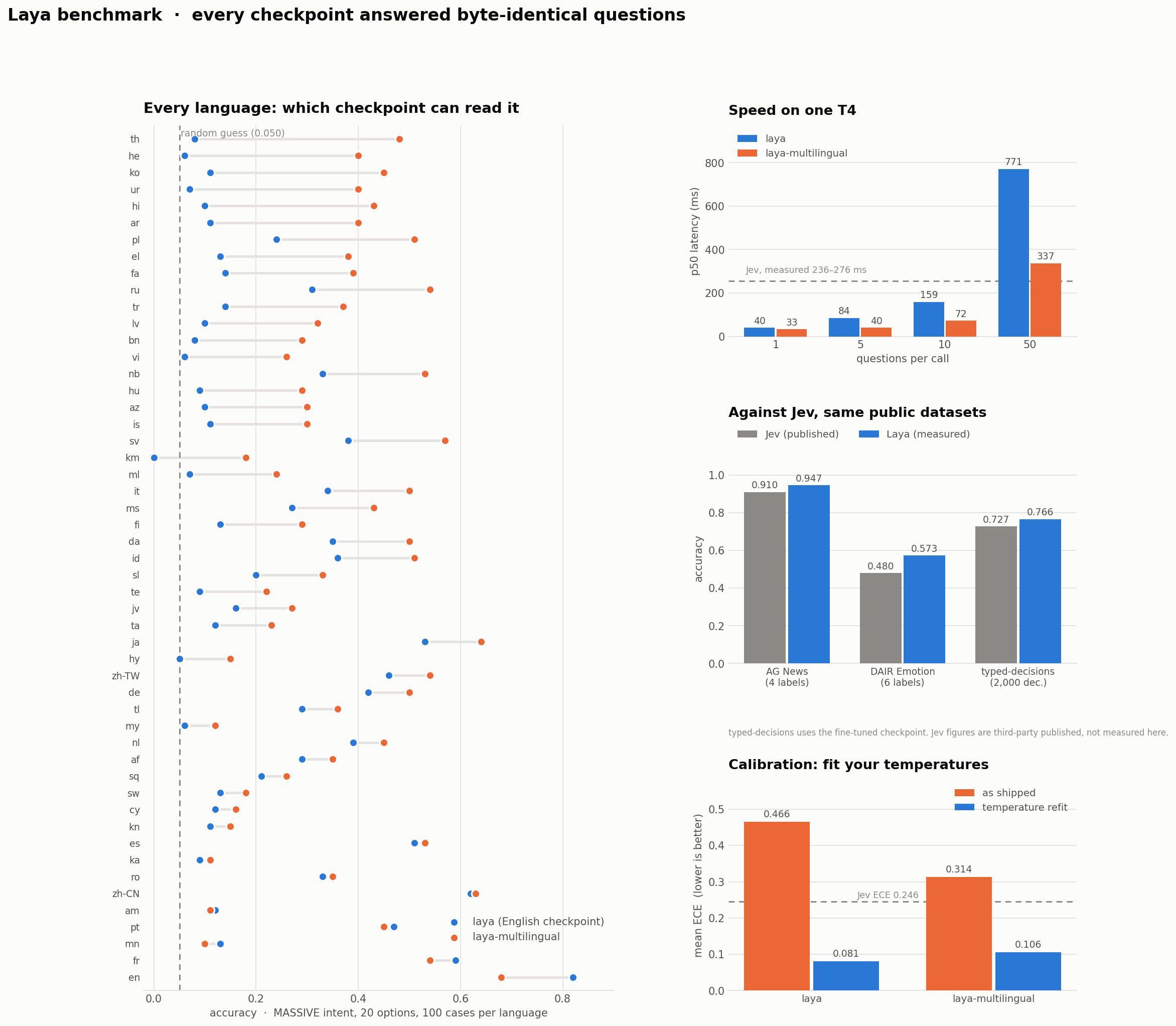
All Laya numbers below are measured. Every model answered byte-identical questions
(fixed seed) in the same run. Reproduce with
notebooks/laya_benchmark_colab.ipynb on a T4.
Speed (Tesla T4, measured)
| questions per call | laya |
laya-multilingual |
|---|---|---|
| 1 | 39.5 ms | 32.8 ms |
| 5 | 84.5 ms | 40.1 ms |
| 10 | 158.6 ms (15.9 ms/q) | 72.3 ms (7.2 ms/q) |
| 50 | 771 ms | 337 ms (6.8 ms/q) |
Batched throughput reaches 103-332 questions/sec on a single T4. For reference, TypeSafe Jev has been independently measured at 236-276 ms p50 (AbdelStark, nibzard) -- Laya answers a single question roughly 6-7x faster.
Laya (with routing) vs Jev
Every Laya figure is what Router().predict(...) actually returns — the checkpoint the router
selects for that input, not a hand-picked best of three. Jev figures are third-party
published, never measured here (no TypeSafe API access), so sample sizes and prompts differ.
| Jev 1.13.0 | Laya (routed) | ||
|---|---|---|---|
| typed-decisions, 2,000 decisions | 0.727 | 0.766 | +0.039 |
| AG News, 4 labels | 0.910 | 0.950 | +0.040 |
| DAIR Emotion, 6 labels | 0.480 | 0.595 | +0.115 |
| ECE (lower better) | 0.246 | 0.081 | 3× better |
| p50 latency, 1 question | 236–276 ms | 32.8 ms | 7.8× faster |
| Languages usable | no published benchmark | 45 of 51 | — |
| Weights | closed API | Apache 2.0 | — |
| Cost | $0.042 / 1M tokens | $0 self-hosted | — |
On DAIR Emotion, Jev assigned zero probability to the true label on 16% of examples — a hard failure for anything branching on confidence.
Full detail, including every workflow and all 51 languages: BENCHMARKS.md.
typed-decisions, measured on all three checkpoints
400 cases, 2,000 decisions, four workflows.
| model | accuracy | soft acc | Brier | ECE | score MAE |
|---|---|---|---|---|---|
laya-typed-decisions |
0.766 | 0.471 | 0.062 | 0.213 | 0.242 |
laya |
0.362 | 0.332 | 0.316 | 0.175 | 0.694 |
laya-multilingual |
0.342 | 0.326 | 0.439 | 0.285 | 0.687 |
| Jev 1.13.0 (published) | 0.727 | 0.580 | 0.148 | 0.144 | 0.391 |
| teacher self-agreement ceiling | 0.735 | ||||
| per-question majority class | 0.461 | ||||
| random guess | 0.318 |
The fine-tuned checkpoint beats Jev by 3.9 points and clears the teacher ceiling, with 2.4x
better Brier and 1.6x better score MAE. It wins on all four workflows: invoice processing
0.804, security incidents 0.766, customer service 0.764, agent-trace observability 0.730.
By primitive: noul 0.857, choice 0.733, score 0.723.
Two places it still trails Jev: soft accuracy (0.471 vs 0.580 — its argmax is better but its distributions match the teacher less well) and ECE (0.213 vs 0.144), which temperature fitting addresses.
The base checkpoints sit below the majority-class baseline (0.362 and 0.342 against 0.461). All of the capability on this benchmark comes from fine-tuning.
Multilingual (51 languages, MASSIVE intent, 20 options, random = 0.050)
laya |
laya-multilingual |
|
|---|---|---|
| English | 0.783 | 0.657 |
| 13 other languages | 0.306 | 0.451 |
| XNLI, English | 0.860 | 0.843 |
| XNLI, 14 other languages | 0.521 | 0.731 |
Across all 51 languages the English checkpoint macro-averages 0.227 with macro ECE
0.733, and only 23 of 51 languages clear 3x random. Khmer scores 0.000 at 95.2%
confidence. This is why Router exists: the
model's own confidence gives no warning, so the routing decision has to be made before the
forward pass.
English tasks
| task | laya |
laya-multilingual |
note |
|---|---|---|---|
| AG News | 0.947 | 0.937 | in training mix |
| BoolQ | 0.830 | 0.787 | in training mix |
| DAIR Emotion | 0.573 | 0.513 | held out |
| prompt-injections | 0.698 | 0.578 | held out, n=116 |
| SST-5 (ordinal) | 0.372 | 0.282 | held out |
Calibration
Both checkpoints are over-confident as shipped. Refitting one temperature per (question type,
option count) on held-out data moves mean ECE 0.466 -> 0.081 (laya) and
0.314 -> 0.106 (laya-multilingual). laya-multilingual ships with no fitted
temperatures at all, so fit them before relying on its probabilities.
Honest limits
- The base checkpoints are near chance on typed-decisions zero-shot -- 0.362 and 0.352 against a 0.318 random baseline and a 0.461 majority-class baseline. The 0.766 figure comes from the checkpoint fine-tuned on that benchmark's own training split. Laya is a fast base to specialise, not a zero-shot decision engine.
- Keep
choicequestions under ~20 options. Every option is rendered into a fixedhead_max_lenbudget (192 tokens onlaya, 256 on the others), so a 77-option question leaves roughly 4 tokens per label and the option text stops being distinguishable — accuracy falls off sharply. Split large label spaces into a coarse choice followed by a fine one. - Ordinal
scorequestions are the weakest primitive (SST-5 0.372). layacollapses outside English;laya-multilingualis weaker on English. Route, or pick deliberately.
Live Demo & Resources
- Hugging Face Model: convaiinnovations/laya
- Interactive Web Demo: convaiinnovations/laya-demo
- Engineering Writeup: Read the full story on Dev.to
Fine-Tuning
Fine-tune Laya on your own domain data. The notebook runs on Kaggle's free 2xT4 GPUs and does the whole loop: build the dataset, train with RLCD (proper-scoring-rule rewards, GRPO-style policy gradient), fit calibration temperatures, evaluate, and push the result to the Hub.
Fine-tuning is where most of the value is. On the typed-decisions benchmark the base checkpoints score near chance zero-shot (0.36 and 0.35 against a 0.318 random baseline), while the fine-tuned checkpoint reaches 0.766 on the same 2,000 decisions -- above TypeSafe Jev's published 0.727 and above the 0.735 teacher self-agreement ceiling. Treat Laya as a fast base to specialise, not as a zero-shot decision engine.
Runtime on 2xT4 is roughly 4-5 hours for 4 epochs over ~30k questions.
Support the Project
If Laya helps your research or products, consider supporting independent research:

License
Apache 2.0. Developed by Convai Innovations.